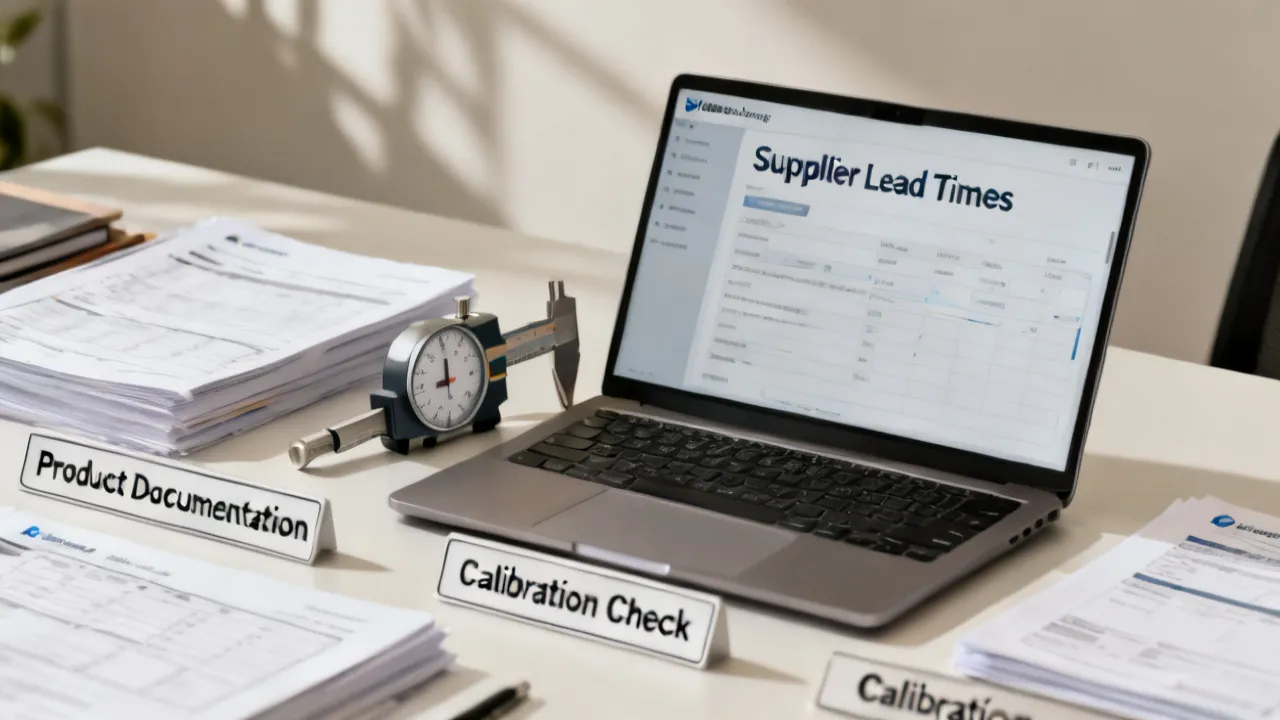
Benevaldo: Supplier Sourcing and Decision Guide
This guide explains how to evaluate Benevaldo-related supplier sourcing decisions with an objective, procurement-focused approach. Background context clarifies what “Benevaldo” typically signifies in sourcing discussions, why supplier transparency matters, and how buyers can structure comparisons, due diligence, and requirements. Readers learn practical conditions to validate quality and reduce risk.

1) Benevaldo sourcing decisions: start with verification, not assumptions
When teams discuss Benevaldo, the practical question is usually not “what sounds good,” but which supplier can be verified, audited, and consistently delivered under real operating conditions. An expert procurement lens treats “Benevaldo” as a category of supply evaluation: you assess capabilities, documentation, lead times, compliance posture, and total cost of ownership rather than relying on a single quotation or brand confidence. In other words, the procurement team’s job is to replace uncertainty with evidence—evidence that can be inspected before a purchase order is placed, and evidence that can be used to manage risk after delivery.
In the sourcing process, buyers often encounter three common traps: (1) focusing on a headline “price” without parsing payment terms, freight, inspection costs, and change-management; (2) selecting a supplier based on marketing materials instead of traceable evidence; and (3) skipping structured requirements for quality, packaging, and documentation. These traps are not caused by negligence; they arise naturally when timelines are tight, procurement bandwidth is limited, or stakeholders want quick consensus. This guide is built to help you avoid those pitfalls and make a defensible decision around Benevaldo.
To do that effectively, the first mindset shift is to treat Benevaldo not as a label but as a procurement outcome. Your desired outcome is not “a supplier who says they can deliver Benevaldo,” but rather “a supplier who can repeatedly produce the correct specification, ship it with the required paperwork, withstand scrutiny from QA/compliance, and resolve issues quickly if something goes wrong.” This outcome framing changes how teams request information, compare offers, and write acceptance criteria.
Verification should be the starting point because supplier claims are rarely uniform. Even if two suppliers both “offer Benevaldo,” they might mean different variants, different tolerances, different packaging configurations, different testing depth, or different revision levels. The procurement role is to force clarity early—before the buying organization locks itself into assumptions that become expensive later.
Consider a typical failure mode: a buyer requests pricing, receives a low quote, and then discovers that the low quote excludes documentation such as certificates of analysis, compliance statements, or traceability records. When downstream stakeholders reject shipments due to missing paperwork, the buyer pays for rework, expedites, storage delays, or even operational downtime. That cost is real, but it did not appear in the supplier’s initial price line. The fix is not to “negotiate harder,” but to verify scope and requirements with structured inputs and evidence.
2) Why supplier comparison is the backbone of any Benevaldo evaluation
From an industry perspective, supplier evaluation is essentially risk management. Even if “Benevaldo” in your context refers to a product line, program, or sourcing arrangement, the decision mechanics remain the same: you must connect supplier statements to measurable proof. That means confirming what the supplier can do, how they do it, how they prove it, and how they respond when issues occur. Procurement cannot do this well by relying on a single questionnaire or a single email thread; it needs a repeatable evaluation framework.
Supplier comparison must cover at least the following dimensions:
- What exactly is being supplied (specifications, variants, grade, and acceptable tolerances). The evaluation must prevent “equivalent” substitutions unless they are explicitly approved by your change management process.
- How quality is controlled (inspection points, test methods, records retention, corrective action process). Quality control is not a slogan; it is a workflow.
- How delivery reliability is demonstrated (on-time performance evidence, backlog handling, escalation steps). Delivery reliability requires data, not promises.
- How changes are managed (part substitutions, revision control, notice periods). Without change management, “same item” may not remain the same item.
- What documentation accompanies shipments (certificates, compliance statements, traceability). Documentation is part of acceptance.
Importantly, reputable sourcing does not depend on one “top” quote. It uses a consistent framework so the winning supplier is the one with the lowest risk-adjusted total cost, not the low price line item on paper. In practice, “risk-adjusted total cost” means you quantify both direct and indirect costs: direct costs (unit price, packaging, freight, inspection), and indirect costs (administrative time, compliance delays, re-testing, downtime, scrap, and the cost of managing disputes).
Supplier comparison also reduces negotiation bias. When you evaluate suppliers consistently, you can negotiate from a position of structured knowledge. You can ask “why is your documentation package incomplete” or “what leads to your shorter lead times” or “how do you guarantee the same revision level,” rather than negotiating purely on price without understanding underlying process maturity.
To make supplier comparison real (not theoretical), procurement teams should also establish a scoring model or at least a “decision logic” matrix. Even if you keep it lightweight, it should reflect your organization’s operational priorities. For example, if Benevaldo supply impacts downstream regulatory compliance, documentation and traceability should carry more weight than small differences in unit cost.
3) Price considerations for Benevaldo: interpret quotations through total cost
Teams frequently ask for price first, because quotations are fast and easy to compare. However, expert buyers treat price as a component of total cost of ownership. A quotation for a Benevaldo-related supply should be read like a contract draft, not a casual offer. The practical parsing questions include:
- What is included: unit cost, packaging method, labeling, documentation, and any mandatory inspections. Make sure “included” is defined; “we include standard documents” is not enough unless you define the set.
- What is excluded: special handling, express shipping, overtime delivery fees, or third-party testing. Exclusions should be listed clearly to avoid surprise invoices later.
- Payment terms: net terms, upfront deposit requirements, and incentives that could distort ordering patterns (e.g., volume discounts with purchase commitment clauses).
- Incoterms / delivery responsibility (if applicable): who bears transit risk and how damage claims are handled. For some supply categories, damage disputes can become a hidden cost.
- Warranty or responsibility clauses: how nonconformance is addressed (rework, replacement, credit). Warranty terms can determine the financial consequences of quality issues.
When available, using standardized evaluation criteria prevents “scope creep.” For example, two suppliers might quote the same unit cost but one includes compliance documentation and the other does not—meaning the buyer effectively pays more later through administrative effort, delays, or re-testing.
There is also a timing dimension to total cost. A supplier that offers a low unit price but has longer lead times can force your organization to hold more safety stock. That increases warehouse costs, capital tied up in inventory, obsolescence risk, and the complexity of demand forecasting. Conversely, a supplier with higher unit price but shorter and more reliable lead times might reduce total cost overall. Procurement should consider this operational reality when comparing Benevaldo offers.
Another price pitfall is the “unit price illusion” created by packaging and documentation. If one supplier’s packaging protects against damage during transit and includes traceability labeling, you may reduce claims and reduce downstream inspection burden. In that case, packaging quality and documentation accuracy are part of what you are paying for—even if they do not appear in the unit price field.
Finally, procurement teams should interpret price quotes alongside contract risk. A cheap quote with vague responsibility terms can be more expensive than a higher quote with clear nonconformance handling. For instance, if the supplier’s terms shift responsibility for documentation errors to the buyer, your QA team may spend additional time chasing corrections, while production schedules stall. Total cost includes the “cost of time,” not only the “cost of product.”
4) Supplier due diligence for Benevaldo: what to ask and why it matters
Even without detailed location cues in your prompt, supplier due diligence should follow universally accepted procurement practice. In Benevaldo discussions, due diligence is often the deciding factor between a smooth relationship and repeated friction. It helps your organization avoid the scenario where you select a supplier because of a persuasive sales narrative, only to discover gaps in quality, compliance documentation, or operational capacity after purchase orders are issued.
From a compliance and operations standpoint, ask for evidence on the following:
- Quality management system (e.g., documented procedures, internal audit cadence, corrective action records). Evidence can include standard operating procedures excerpts, audit summaries, or example corrective action reports.
- Traceability capability: lot tracking, revision control, and record retention duration. Ask how traceability is maintained across subcontractors and shipping stages.
- Nonconformance response: how complaints are logged, investigated, and resolved. You want to see the workflow, timelines, and examples of root-cause outcomes.
- Capacity and continuity planning: how supply is maintained during demand spikes or component shortages. Capacity should be supported by evidence, not assumptions.
- Documentation accuracy: sample certificates, inspection reports, and how they are validated. Documentation accuracy is measurable: check sample sets for consistency and alignment with shipment identifiers.
If the supplier cannot provide clear documentation or demonstrates inconsistent answers, the buyer should consider that a risk signal—not necessarily because they are “bad,” but because the procurement team will likely absorb the uncertainty. Uncertainty is expensive in procurement; it drives extra internal labor, additional inspection, delayed acceptance, and more frequent escalation.
Due diligence should also include an escalation and dispute readiness assessment. Many procurement teams focus only on product quality evidence. But operational friction often begins during nonconformance events: who responds, how quickly, and what authority the supplier’s technical lead has. You want to know the supplier’s ability to coordinate corrective actions across departments—engineering, quality, operations, and logistics—without blaming the buyer.
Another due diligence dimension is subcontractor and supply chain transparency. If Benevaldo involves raw materials, specialized components, or outsourced processes, the supplier must explain how they control subcontractor quality. Otherwise, your buyer risk is simply moved upstream with no visibility.
Finally, due diligence should incorporate governance: contact structure, meeting cadence, and performance reporting. A supplier that provides monthly quality and delivery summaries typically has more mature operations and a better understanding of buyer accountability. Procurement should ask for a sample performance dashboard or a history of quality metrics and on-time delivery indicators (even if anonymized).
5) Conditions and requirements (comparison framework)
Below is a structured comparison table you can use as a supplement to your Benevaldo sourcing workflow. It is deliberately practical and emphasizes objective conditions and verification needs. (No links are used.) The table is designed to keep the evaluation aligned with what QA, compliance, and operations will actually need after purchasing decisions are made.
| Evaluation Area | What to Require for Benevaldo Sourcing | Evidence to Request | Decision Trigger |
|---|---|---|---|
| Product/Service Specifications | Clear technical definition, allowed tolerances, and approved variants | Spec sheets, revision history, acceptance criteria | Incompatibility or vague specs leads to clarification or rejection |
| Quality Control | Documented inspections and measurable acceptance tests | Inspection plans, test methods, sample inspection reports | Missing tests or non-repeatable results increase operational risk |
| Traceability | Lot or batch tracking with retained records | Traceability procedure, record retention policy | No traceability prevents root-cause analysis after issues |
| Delivery Reliability | Lead-time clarity and escalation pathways | Delivery performance summary, backlog handling process | Frequent schedule variability without mitigation is a red flag |
| Documentation Package | Consistent certificates and shipment paperwork | Sample documentation set, validation approach | Incomplete or inconsistent documentation causes compliance delays |
| Change Management | Defined notification rules and approval workflow | Change control procedure, substitute approval policy | Uncontrolled substitutions jeopardize specification compliance |
| Commercial Clarity (Price Terms) | Transparent cost breakdown, payment terms, and warranty responsibility | Full quotation breakdown, terms and conditions, warranty clauses | Hidden cost drivers or unclear responsibility shifts total cost upward |
To make the table even more effective, procurement teams can add an “evidence quality rating” column during evaluation. For instance:
- Evidence that is complete, signed, and consistent earns a higher score.
- Evidence that is generic, template-based, or missing identifiers earns a lower score.
- Evidence that is inconsistent across sample shipments should be treated as a failure, because it predicts future problems.
In practice, some suppliers provide partial documentation sets quickly but fail to provide traceability evidence or retention policies. Those gaps should not be treated as minor; they are often linked. If the supplier cannot track the product internally, the supplier likely cannot defend quality decisions after nonconformance events.
6) Step-by-step guide: how to run a Benevaldo procurement evaluation
Use this as a structured guide for procurement teams evaluating Benevaldo-related supply options. The goal is to reduce subjective bias and create an audit trail for future decisions. Auditability matters because procurement decisions often get reviewed later by internal audit, finance, legal, QA, or compliance committees. A defensible decision is one where the logic can be explained years later without relying on memory.
Step 1: Define scope and acceptance criteria
Write a one-page scope statement: what you need, in what quantity range, with what specifications, and how you will validate acceptance. If your Benevaldo context involves multiple variants, specify the variants explicitly and define acceptable tolerances. Make “acceptance” precise enough that QA can perform it without guessing.
Strong acceptance criteria typically include:
- Document requirements (what certificates, what identifiers, who signs).
- Physical/technical requirements (tolerances, grade, dimensional requirements).
- Packaging and labeling requirements (what labels appear on what documents, how barcodes/part numbers map to the shipment).
- Sampling plan (if you use sampling, define the sample size, acceptance thresholds, and inspection method).
- Nonconformance handling rules (how issues are reported and resolved).
By defining these up front, you reduce disputes. Suppliers can price and plan better when requirements are clear, and buyers can evaluate apples-to-apples.
Step 2: Collect quotes using the same specification template
When requesting price, ensure each supplier receives identical input: packaging requirements, labeling expectations, required documentation, and delivery conditions (including whether expedited services are optional). This is where many evaluations quietly diverge.
To prevent divergence, procurement teams can include a “quote worksheet” that forces suppliers to answer the same fields:
- Unit price by variant/grade.
- Packaging cost inclusions and what those costs cover.
- Documentation package inclusions and whether any documents are excluded.
- Delivery terms and lead-time estimates.
- Warranty/nonconformance handling summary.
If a supplier deviates from the template, procurement should require written clarification so that comparisons remain valid.
Step 3: Perform document and capability review
Request quality and traceability evidence. Look for documented processes rather than only statements of intent. A capable supplier can typically share sample reports, standard inspection plans, and documentation examples. You should also assess whether the supplier’s quality processes align with your acceptance criteria.
Procurement should work with QA/compliance here. The buyer needs to interpret the evidence, not just collect it. For example, a supplier might provide a certificate template that looks complete, but the buyer should check whether identifiers match shipment data fields. Procurement can also request evidence of corrective action closure timelines and examples of root-cause analysis outcomes.
Step 4: Validate through targeted sampling (where appropriate)
If feasible, perform a small-scale validation: a pilot shipment, prototype evaluation, or controlled trial. The key is not only whether items pass, but whether the documentation matches the shipment and whether the resolution workflow is effective when issues appear.
Targeted sampling is especially valuable when:
- The supply is new to your organization or has not been sourced from this supplier before.
- There is historical quality variability in the category.
- Traceability and documentation quality are critical for compliance.
Even if the pilot is small, it can reveal whether the supplier’s quality and documentation processes are operationally mature or merely “paper mature.” A supplier may produce acceptable items once, but fail to maintain consistent processes across multiple lots.
Step 5: Assess commercial terms as contract risk
Compare warranties, responsibility for nonconformance, replacement timelines, and credit terms. Price alone can mislead; contract language often determines how the buyer is treated during disputes.
During contract risk assessment, procurement should focus on:
- How quickly the supplier must respond to nonconformance notices.
- Who pays for re-testing, replacement, and shipping costs when defects occur.
- Whether warranties cover documentation errors (not just physical defects).
- Whether contract terms permit unilateral substitutions without approval.
- How change control works in the contract (notification windows, approval requirements).
When these terms are unclear, procurement should not rely on “trust.” Legal clarity prevents costly ambiguity.
Step 6: Make a decision using a risk-adjusted scoring model
Weight criteria based on your operational criticality. For example, if the Benevaldo-related supply impacts downstream compliance, documentation quality might be weighted more heavily than a small difference in unit cost.
A practical scoring model often uses both:
- Hard requirements (must meet): e.g., traceability capability, required documentation package availability, defined inspection/testing acceptance criteria.
- Soft differentiators (should optimize): e.g., delivery performance history, supplier responsiveness, turnaround times for corrective actions, and continuous improvement initiatives.
In addition, procurement should explicitly quantify “cost of risk.” Even if exact cost is difficult, procurement can approximate using internal estimates (e.g., cost per day of downtime, cost per rejected lot, administrative effort per nonconformance case).
Step 7: Implement an ongoing performance review
After the selection, set measurable KPIs: on-time delivery performance, defect rates, documentation completeness, and corrective action cycle time. Expert procurement treats the first quarter as a calibration period rather than assuming the relationship is stable from day one.
Performance review should include:
- Monthly delivery and quality summaries.
- Documentation completeness checks (a simple “document received complete vs incomplete” metric).
- Corrective action closure monitoring and escalation thresholds.
- Change management confirmations (ensure suppliers notify as required).
Ongoing review is what protects the buyer once the contract is in motion. It transforms the relationship from reactive firefighting to proactive governance.
7) Supplier selection risks in Benevaldo projects (and how to mitigate them)
Even well-run procurements encounter risk. The professional approach is to identify risk categories early and mitigate them with contractual and operational controls. In Benevaldo projects, the risk is not only that the product is defective; the risk is that the entire supply system—documentation, traceability, responsiveness, and revision control—fails to behave as expected.
Common risks and mitigations include:
- Specification drift: mitigated by revision control and change notification terms. Add a clear rule that substitutions require prior written approval, and define what constitutes equivalence.
- Documentation gaps: mitigated by requiring a defined document package per shipment. Specify when documents must arrive (e.g., before shipment release or within a set number of business days).
- Quality inconsistency: mitigated by inspection plan alignment and nonconformance procedures. Ensure your acceptance criteria match supplier tests and define corrective action triggers.
- Delivery uncertainty: mitigated by lead-time clarity and escalation SLAs. Include a schedule adherence metric and a mechanism for expediting or re-planning if lead times slip.
- Cost escalation: mitigated by transparent pricing breakdowns and defined fee schedules. Define what costs are variable and what costs are fixed within the contract period.
There are additional, often overlooked risks:
- Traceability failure: mitigated by requiring lot identification mapping to your receiving system and record retention evidence.
- Subcontractor risk: mitigated by asking how your supplier controls subcontracted processes and whether they flow down requirements to partners.
- Communication failure: mitigated by defining response timelines, escalation contacts, and meeting cadence for performance review.
- Regulatory or compliance interpretation mismatch: mitigated by clarifying which standards/regulatory requirements apply to your use case and requiring documentary proof.
Risk mitigation should not be treated as “heavy bureaucracy.” It should be proportional to criticality. For high-criticality supplies, stricter evidence requirements and more frequent performance reviews may be justified. For low-criticality items, lighter controls may be acceptable—but procurement should still require minimum documentation completeness and nonconformance handling clarity.
8) Expert perspective: how “Benevaldo” discussions influence buyer behavior
From an industry expert’s standpoint, the term Benevaldo often functions as a shorthand buyers use to describe a sourcing intent—what they want, the expected baseline quality, and the type of supplier relationship they prefer. That shorthand can be useful, but it can also hide complexity if procurement teams stop asking clarifying questions.
Therefore, the very effective teams operationalize “Benevaldo” as measurable requirements. Instead of interpreting it as a brand promise, they interpret it as a specification + process expectation. This shift—from narrative to evidence—is what separates reliable sourcing outcomes from recurring operational surprises.
To illustrate this behavior shift, consider how “Benevaldo” might be used in meetings:
- Less effective behavior: “Let’s just get Benevaldo from that vendor; they’ve done it before.”
- More effective behavior: “We need Benevaldo with these exact specs, these tolerance limits, this documentation package, and this traceability approach. Let’s confirm their revision control process and run a pilot shipment.”
In procurement terms, the difference is whether the team is managing outcomes or managing assumptions. Assumptions may work once, but they do not scale. When organizations scale procurement across multiple sites or multiple supply categories, evidence-led processes are essential.
Expert teams also influence stakeholder behavior. When procurement uses structured templates for RFQs and uses scoring matrices, stakeholders become less likely to argue based on subjective preferences. Instead of debating “supplier X seems reliable,” stakeholders debate “Supplier X scored highest on documentation completeness and traceability, and met all hard requirements.” That changes the conversation from opinions to evidence.
Finally, expert behavior includes communication discipline. If procurement chooses Supplier Y, procurement should communicate the rationale clearly: which requirements were met, what risks were accepted, and how performance will be monitored. This transparency prevents internal friction later and helps ensure that QA and operations remain aligned with procurement decisions.
9) Source-based context: procurement evaluation aligns with recognized standards
While your prompt does not provide specific studies tied to Benevaldo, supplier evaluation top practices are consistent with widely adopted quality and management system concepts. For example:
- ISO 9001 emphasizes process-based quality management and continual improvement, including nonconformity handling and corrective actions.
- ISO 9000 provides fundamentals and vocabulary for quality management systems.
- OECD guidance for responsible business conduct supports due diligence expectations relevant to supplier relationships.
Reliable sources: International Organization for Standardization (ISO) publications; OECD due diligence guidance (official OECD materials).
Procurement teams should use standards as a lens, not as a checkbox. A supplier might be ISO-certified, but that certification does not automatically guarantee your specific Benevaldo-related requirements are met. Your organization should still verify documentation quality, traceability processes, and operational performance.
Standards also reinforce the concept of continual improvement, which can be used in performance reviews. Instead of only tracking defect rates and delivery on-time performance, buyers can also track corrective action effectiveness, root-cause depth, and repeat nonconformance frequency. These metrics reflect whether suppliers are improving processes rather than merely reacting to issues.
When due diligence includes responsible business conduct, procurement can also assess whether supply chain risks are managed appropriately. Depending on the nature of the Benevaldo supply category, this might include labor practices, environmental compliance, and ethical sourcing requirements. If your organization has ESG or compliance obligations, integrate them into your supplier evaluation framework so decisions remain coherent across procurement and governance functions.
10) FAQs about Benevaldo supplier sourcing
Q1: What does Benevaldo mean in a sourcing context?
In many supplier conversations, Benevaldo refers to a procurement intent or category of supply expectations. Practically, treat it as a signal to confirm the exact specifications, documentation needs, and quality/traceability requirements that apply to your use case. Even if “Benevaldo” is internally understood, you still need external suppliers to define precisely what they will deliver.
Q2: Should I choose the supplier with the lowest price for Benevaldo?
Not automatically. Expert procurement evaluates risk-adjusted total cost, including documentation work, inspection needs, rework/returns, contract responsibility, and the cost of operational downtime caused by nonconformance. Price is important, but it is rarely the only determinant.
Q3: What supplier documents are very important for Benevaldo evaluations?
Typically, the priority documents include product/service specifications, inspection and test evidence, traceability or record retention procedures, and a consistent documentation package per shipment. The “must-have” list should be tied directly to your acceptance criteria. If documentation is missing or inconsistent, treat it as operational risk rather than an administrative inconvenience.
Q4: How can I verify quality for Benevaldo if I cannot inspect every shipment?
Use a risk-based approach: agree on inspection points, acceptance tests, and corrective action timelines. Where feasible, validate with a pilot or sampling plan. Then require documentation completeness for each shipment so you can audit outcomes. In some cases, you may also negotiate supplier-managed inspection with third-party oversight depending on criticality.
Q5: What requirements should be included in a contract for Benevaldo-related supplies?
Include specification definitions, quality responsibilities, nonconformance handling (including replacement/rework/credit terms), change management rules, documentation requirements, delivery expectations, and escalation pathways for disputes. Ensure the contract language aligns with your operational reality so QA and procurement can enforce it consistently.
Q6: Can I rely on supplier claims without evidence?
Claims alone are insufficient. A professional evaluation seeks evidence such as documented processes, sample records, and consistent responses to structured questions. If a supplier cannot provide verifiable materials, that uncertainty should be treated as a risk factor and should influence scoring and contract terms.
Q7: Do I need an on-site audit for Benevaldo sourcing?
Not always. Some evaluations can start with document review and a controlled sampling/pilot. However, if the supply is high criticality or past issues occurred, an audit—remote or on-site—can strengthen confidence. The audit should have a clear purpose: verify traceability processes, quality control workflow, change management governance, and the supplier’s ability to close corrective actions effectively.
11) Conditions to keep your Benevaldo sourcing evaluation defensible
To protect your procurement decision from bias and ensure it withstands internal review, establish these baseline conditions:
- Use the same specification template for every supplier quotation. This prevents apples-to-oranges comparisons.
- Score suppliers against defined criteria (quality, traceability, documentation, delivery reliability, and commercial terms). Avoid ad hoc scoring.
- Require evidence, not just statements. Tie evidence requests to each evaluation area.
- Document assumptions (e.g., what was included in price and what was excluded). Assumptions must be recorded for traceability.
- Define escalation steps for defects and schedule slippage. Ensure escalation is both contractual and operationally executable.
Defensibility also includes governance around decision timing. Procurement should maintain version-controlled records of RFQs, supplier responses, evaluation notes, scoring sheets, and negotiation outcomes. This ensures that if the decision is challenged later, the organization can demonstrate a rational and fair process.
Another defensibility condition is transparency with internal stakeholders. If QA and compliance have a veto or “go/no-go” role, clarify it. If procurement intends to accept certain risks (e.g., slightly less mature traceability evidence), document why the risk is acceptable and what compensating controls will be used (e.g., tighter receiving inspection or longer pilot period).
Finally, procurement defensibility includes how you manage non-winning suppliers. Provide closure and maintain a professional approach. This reduces future negotiation friction and preserves relationships for emergency sourcing needs or future contracts.
12) Practical next actions for buyers considering Benevaldo
If your team is actively evaluating Benevaldo-related suppliers, the very productive next step is to convert your interest into a structured request for information (RFI) or quotation (RFQ) that includes specifications, documentation requirements, and acceptance criteria. Once you collect comparable outputs, you can run a scoring model, then validate with a pilot shipment or sample-based verification (as appropriate).
To make this next step effective, consider launching the process with a short pre-RFQ alignment meeting with QA, compliance, warehouse/receiving, and operations. Procurement will draft the RFQ, but these functions can ensure that requirements match how acceptance and receiving actually happen. For example, warehouse personnel may need clarity on labeling and packaging requirements to correctly identify items and store them. QA may need test method details to validate inspection results. Compliance may need evidence types and record retention confirmation. When these stakeholders align early, the RFQ becomes a shared execution plan rather than a procurement-only document.
Once supplier responses arrive, procurement should also conduct a structured consistency check. Look for discrepancies between what suppliers claim and what their documentation samples show. Also check whether lead times align with capacity claims and whether change management processes align with revision control expectations. If suppliers appear inconsistent, procurement should ask clarifying questions and request corrected documentation before awarding.
After selection, implement governance immediately. Set initial KPIs for on-time delivery, documentation completeness, defect rates, and corrective action cycle time. Require periodic reviews and ensure that escalation pathways are known by both procurement and technical leads. In many organizations, performance governance fails when it is delayed; the contract is signed, but operational routines are not established. Avoid that by scheduling the first performance review early—often within the first month of shipments.
By treating Benevaldo sourcing as an evidence-led procurement exercise—rather than a brand-driven assumption—you increase the likelihood of stable performance and reduce avoidable cost over time. Evidence-led sourcing also creates organizational learning: you can reuse evaluation templates, scoring models, and contract clauses for future sourcing events, improving procurement maturity across categories and supplier groups.
Note on your provided keywords and data
Your prompt includes the keyword “Benevaldo,” but does not provide explicit price figures, supplier names, or location details to embed directly. This article therefore focuses on an objective procurement framework and supplier evaluation method around Benevaldo, including how to interpret price and what to verify. If you share the actual price and supplier details you want included, I can produce a revised version with those specifics seamlessly integrated.
-

A Guide to Cost-Efficient Small Electric Cars for Seniors
-
Mastering Debt Consolidation: Boost Your Credit Score and Manage Interest Rates
-
Your Guide to Loans, Credit Checks, and Interest Rates
-
Affordable Independent Living: Finding the Right Senior Housing
-
Guide to Senior Living Apartments: Affordable and Comfortable Environments